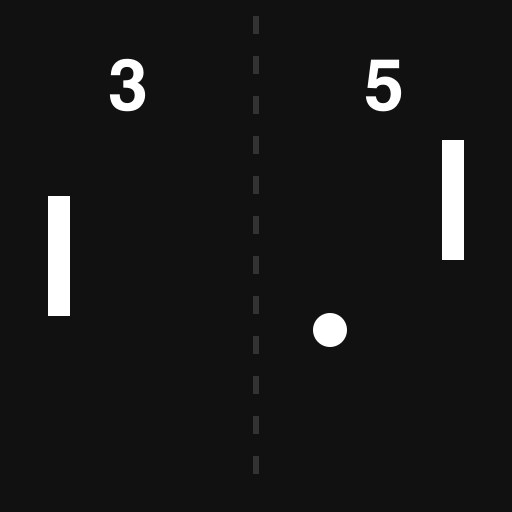
What Is Pong?
Pong is the original commercial video game — a two-player table-tennis simulation in which each side controls a vertical paddle and tries to be the last to keep the ball in play. Released by Atari in 1972, it was the first video game to reach mass-market commercial success and is widely credited with launching the entire arcade industry. The rules take ten seconds to explain and the strategy takes years to master, which is exactly why Pong is still being played, forked, and reimagined more than half a century later.
How to Play Pong
The screen is split vertically into two halves. Each player controls a paddle that can move up and down along their side of the screen — the left paddle is controlled by the W/S keys (or the up/down arrows), the right paddle by the same keys or by an AI opponent. A ball bounces between the two paddles; if a paddle hits it, the ball flies back; if a paddle misses, the opponent scores a point. First to 11 (or 21, in arcade tradition) wins.
The angle of your paddle when the ball lands determines the angle of the return: hit the ball with the centre of your paddle for a flat return, the top edge for a sharp upward angle, or the bottom edge for a sharp downward angle. Skilled players manipulate this to send the ball to the corners of the opponent's side where it is hardest to reach.
The ball speeds up slightly with every successful paddle hit, so rallies get progressively harder the longer they run. The classic Pong match is a test of reflexes, anticipation, and angle management rather than pure reaction speed.
Controls
- W / S — move the left paddle up and down
- Up / Down Arrows — move the right paddle (or second player)
- Mouse — drag your paddle vertically (some versions)
Winning Tips
Stay centred when defending. The centre of the screen is the optimal defensive position because it minimises the distance to either corner. Return to centre the instant your paddle hits the ball; do not drift toward where you just sent the return.
Use the paddle edges for sharp angles. A flat-centre hit returns the ball at the same angle it came in; an edge hit redirects it sharply. Mix the two so your opponent cannot predict where the next return will land.
Predict, do not chase. Once the ball has left your opponent's paddle, its trajectory is fixed. Move to where it will land the moment you see the angle, not when it is halfway across the screen. Reaction speed matters less than anticipation.
Target the corners. A ball travelling to the corner forces the opponent to cover maximum distance; a ball to the centre lets them stand still. Always aim for the corner furthest from the opponent's current position.
Break rhythm deliberately. If your opponent has settled into a steady back-and-forth, suddenly change pace — a hard flat return, a slow edge angle, an unexpected drop. Breaking rhythm is how you force a mistake.
Why Pong Is Timeless
Pong has no story, no progression, no unlockables, no microtransactions, no load times — just two paddles, one ball, and the universal human instinct to keep a thing in the air. It loads in milliseconds, runs on literally any device with a screen, and works equally well solo against an AI or side-by-side with a friend. The simple ruleset has aged better than almost any other game from the 1970s, which is why Pong's core loop has been re-skinned thousands of times and remains instantly recognisable in every one of them.
Ready to volley? The embedded player is live at the top of this page — press W or Up to begin.
Origins and Community Impact
Pong was designed by Allan Alcorn as a training exercise assigned by Atari co-founder Nolan Bushnell in 1972. Bushnell had asked Alcorn to build a simple game to practise his new video-game programming skills; the result was so polished that Bushnell decided to ship it as an actual product. The first Pong cabinet was installed in a tavern in Sunnyvale, California, and broke within days because the coin mechanism jammed from overuse — a problem Atari was happy to have.
The home version, Home Pong, shipped through Sears in 1975 and was the first home video console to sell in serious volume, predating the Atari 2600 by two years. Pong's commercial success directly funded the Atari 2600, which in turn launched the home console industry. Almost every modern video game genre traces its lineage back through a Pong derivative, which is why the game is preserved in the Smithsonian and taught in game-design courses as the foundation of the medium.
Advanced Tips
Master "snake" returns. Hit the ball with the top edge of your paddle while moving your paddle upward, and the ball will snake — gain a steeper upward angle than a static edge hit. This is the hardest return to defend in the game.
Bait your opponent. Deliberately leave a corner open for one rally, then snap-kill the next ball to that exact corner. The opponent has been conditioned to expect you to cover it; the bait-and-switch is a classic competitive Pong tactic.
Slow your paddle on contact. A fast-moving paddle imparts spin and unpredictable angles, but a paddle that is decelerating at the moment of contact returns the ball at a clean, controlled angle. Use fast movement to position, slow movement to hit.
FAQ
- Q: Can I play Pong solo?
- A: Yes — most browser versions include an AI opponent whose difficulty scales with your score. Two-player local mode is also standard if you have a friend and a keyboard.
- Q: Why is the ball sometimes faster than other times?
- A: The ball speeds up slightly with every paddle hit, so long rallies produce faster and faster play. Some versions also speed the ball if it hits a paddle edge rather than the centre, as a reward for accurate hitting.
- Q: Was Pong really the first video game?
- A: No — Tennis for Two (1958) and Spacewar! (1962) predate it by over a decade. Pong was, however, the first commercially successful video game, which is why it is remembered as the one that started the industry.
- Q: What is a good Pong score against the AI?
- A: If the AI is set to maximum difficulty and you reach 7–11 points, you are playing at a competitive level. Beginners typically score 0–3 against a hard AI.
Similar Arcade Games
- Breakout — the single-player descendant of Pong, designed by the same Atari team
- Tower Defense (Classic) — when you want strategy over reflex
 Tower Defense (Classic)
 Slope
Slope Drift Hunters
 Retro Bowl