Why 2048 Spawns the Best Variants
The original 2048 is a masterpiece of minimalism — four arrow keys, infinite strategic depth. That same simplicity is exactly why developers keep reinventing it. Every new variant adds one fresh mechanic and suddenly the familiar puzzle feels completely different. In 2026 there are three standout variants you can play right now in your browser: 2048 Drop, 2048 Rogue, and 2048 Italian Brainrot. Each one keeps the core merge logic intact while layering on a twist that changes how you think about the board. That balance — familiar foundation, single clever deviation — is what separates a great 2048 variant from a gimmick that falls apart after five minutes.
What Makes a Great 2048 Variant
Not every reskin deserves your time. The variants worth playing share three traits. First, they preserve the original's solvable structure: you can still reason about the board, so skill matters more than luck. Second, they add exactly one new mechanic rather than three at once — a falling chip, a roguelike run, a meme skin — so the twist is easy to learn but hard to master. Third, they keep instant restarts: a bad run costs you thirty seconds, not a saved-game you're afraid to abandon. When a variant nails all three, it feels like a new game built on a foundation you already trust. The four versions on this page are the ones that clear that bar.
The Original: 2048
2048 is the benchmark. Tiles on a 4×4 grid slide in one of four directions; matching numbers merge into their sum. Reach 2048 to win — though the real challenge is pushing past 4096 and 8192. The key principle that carries into every variant: never let your highest tile move away from one corner. Lock the largest tile in a corner, build the second-largest beside it, and work outward in a snake pattern.
If you have never beaten 2048, don't skip the classic before jumping to the variants. The muscle memory you build here — reading the board, planning two moves ahead, resisting the panic swipe — transfers directly. Most players who struggle with the variants are actually struggling with the fundamentals, and ten minutes on the original fixes more than any variant trick.
"The Web Storage API provides mechanisms by which browsers can securely store key/value pairs in a much more intuitive fashion than using cookies."
2048 Drop — Tetris Meets 2048
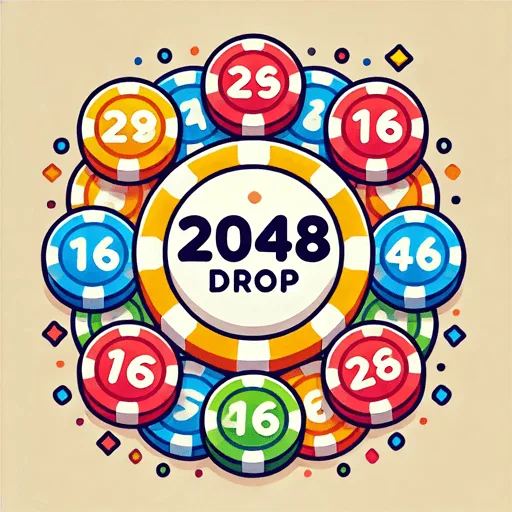
2048 Drop replaces the sliding grid with a falling-chip mechanic. Chips drop from the top of the screen; you position them with ← → and they stack like Tetris pieces. When two matching numbers touch, they merge. The board fills from the bottom up, so clutter accumulates faster than in the original.
Strategy shift: In classic 2048 you control the whole board in one move. In Drop, you control only the next chip's column. Prioritise keeping one column as an "escape valve" — an almost-empty column you can dump awkward low-value chips into rather than blocking your merge lanes. Watch the next-chip preview constantly; the difference between a tidy board and a jammed one is usually decided two chips earlier than you think. Drop is the best entry variant for players who find the original's open board intimidating, because the constraint actually simplifies your decisions.
2048 Italian Brainrot — Meme Tiles, Same Brain Pain
2048 Italian Brainrot replaces numbers with Italian Brainrot meme characters: Tralalero Tralala, Bombardino Crocodilo, Tung Tung Tung Sahur, and the rest of the absurd cast. The merging logic is 100 per cent identical to classic 2048 — identical characters merge into the next character in the evolution chain.
The meme theme makes the game genuinely funnier to play with friends, but it also removes the number anchors your brain uses to track tile values. You have to memorise the character hierarchy to plan combos. Treat the rarest characters exactly as you'd treat high-value numbered tiles — protect them in a corner and never move them unless essential. If you already know the Italian Brainrot universe, this is the most charming way to introduce a friend to the puzzle; if you don't, the character art is distinctive enough that you'll learn the tier order within a couple of runs.
2048 Rogue — Procedurally Fresh Every Run
2048 Rogue adds roguelike elements: randomised starting board states, optional power-up events between levels, and escalating difficulty. Each run ends on failure and starts from scratch, so there is no save-scumming — only improving pattern recognition.
The roguelike randomness means your opening moves matter enormously. Prioritise establishing a corner anchor before the board gets crowded; a chaotic start without a corner strategy snowballs into an unwinnable position quickly. The power-up events are where Rogue diverges most from the other variants: some grant temporary merge bonuses, others shuffle a stuck row. Learn which events you can safely skip — hoarding an event for a genuinely bad board beats spending it on a board that was already fine. Rogue is the most replayable variant here for exactly this reason: no two runs play the same.
A Beginner-to-Advanced Progression Path
If you want to climb from "I've heard of 2048" to "I can reliably hit 2048 on any variant," play them in this order. Start with the classic 2048 to build board-reading habits. Move to 2048 Drop next — the column constraint forces discipline without overwhelming you. Then try 2048 Italian Brainrot to test whether you can plan without number cues; it's the best difficulty checkpoint because regressing to character-tracking exposes weak fundamentals fast. Finish on 2048 Rogue, where randomness punishes any shaky habit you carried over. By the time Rogue feels winnable, you'll beat the classic consistently.
Universal 2048 Strategy Tips
- Corner lock — always keep your highest tile in one fixed corner. Never move it.
- Snake pattern — build your second-largest tile in the same row as the locked corner, third-largest in the row below, and so on in a zigzag. This guarantees merge chains stay connected.
- Two-direction cycling — when stuck, alternate between only two opposite directions (e.g., left and down) to keep tiles flowing rather than scrambling the board.
- Never move toward your corner — moves that push tiles toward the opposite corner will eventually strand your high-value tile and strand it away from its anchor.
- Read the spawn — a new tile appears after every move; keep your "safe" corner clear so the spawn never blocks your anchor. A blocked corner is the start of most losses.
- Don't chase the biggest merge — the satisfying 64+64=128 feels good but often disrupts your snake. Merge small tiles to keep lanes open; let the big merges happen as a side effect.
2048 Variants vs Other Number Puzzles
Players sometimes ask why 2048 variants beat Sudoku, Nonograms, or number-matching match-3 games for a quick brain workout. The answer is agency under time pressure without punishment. Sudoku has one correct answer and punishes a wrong digit permanently; match-3 is reactive and random. 2048 gives you a wrong move's consequence instantly and lets you recover in three swipes. That feedback loop is why 2048 variants are the default "I have five minutes" puzzle on every browser game site — and why the variant format keeps producing genuinely fresh takes instead of fading.
Frequently Asked Questions
Which 2048 variant is the hardest?
2048 Rogue is the hardest because its randomised starts and escalating difficulty remove the predictable opening that the other variants share. 2048 Drop is second-hardest for new players, purely because the falling-chip constraint is unfamiliar. The classic 2048 and 2048 Italian Brainrot sit at roughly equal difficulty — Brainrot only feels harder until you memorise the character order.
Can I play 2048 variants on mobile?
Yes. All four run in any modern mobile browser and respond to swipe gestures, so there's nothing to install. Drop and Rogue benefit from a slightly larger screen if you want to read the board comfortably, but both are fully playable on a phone.
Do my high scores and boards save between sessions?
Each game uses your browser's local storage to remember your best score and, where applicable, your current board, so closing the tab and returning later resumes where you left off. Clearing your browser data or using private mode resets progress — there's no account to sign into, by design.
Are all 2048 variants free?
Every version on this page is completely free to play, with no download, no account, and no paywalled boards. That's true across the entire free games index.
Play All Four Right Now
All four versions are available free in your browser on Poki2 — no download, no account:
