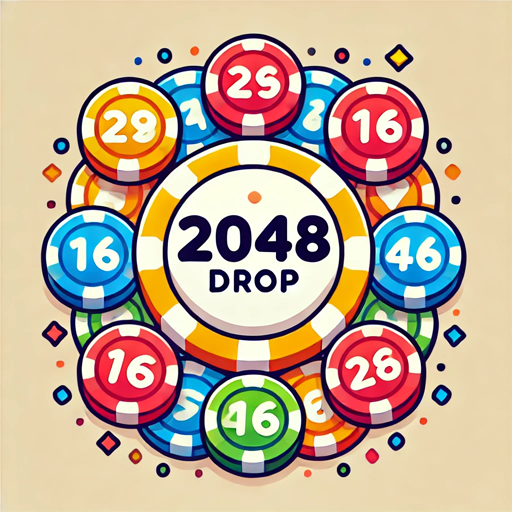
What Is 2048 Drop?
2048 Drop is a falling-chip merge puzzle. Chips drop from above — place matching numbers side by side and they combine into the next value. Your goal is to build a tile worth 2048 before the board fills up.
How to Play
Position the falling chip with ← → keys or your mouse, then let it drop. Identical numbers touching each other merge instantly. Plan every drop — one misplaced tile can block all future combos.
Controls
- ← / → — move chip left or right
- ↓ — drop faster
- Mouse — click column to drop
Tips
Keep your largest tile in a corner and build toward it. Clear chain-merges whenever possible to keep the board clear. If you get stuck, look for the column that unblocks the most future moves.
Gameplay Mechanics in Depth
2048 Drop uses a falling-piece format similar to Tetris — a new chip appears at the top of the board each turn, you position it horizontally, then release it. Once a chip lands, it immediately checks its neighbours for matching values. If the chip is adjacent to an identical number, they fuse into a single chip with the doubled value (2+2=4, 4+4=8, and so on). Chain merges happen instantly: a chip falling into a position that triggers a merge might uncover a new match, which then merges, cascading down the board in seconds.
The board is typically 6 columns wide and 12 rows tall — taller than wide, which means short game sessions can still last a while if you plan drops carefully. The chip values max out at 2048, but the board keeps generating merges and tracking your score long after you've made your first 2048 tile.
Advanced Strategy
Stack the low values in one column. Reserve a single column for small chips (2s and 4s) that you'll merge later — never drop a high-value chip into that column, only low-value ones.
Watch for chain opportunities. A drop that triggers two merges in sequence scores more than two separate drops. Look one move ahead for cascade setups.
Avoid filling the top row. Once the top row is full, the game becomes unwinnable because you can't place new chips. Keep at least one empty cell in the top row at all times.
Use both edges. Most players anchor to one side, but experienced drop players often use both edges — a high chip on the left and a high chip on the right, with chain merges forming in the middle.
FAQ
- Q: What happens after 2048?
- A: The board keeps accepting drops and scoring. Many players push for 4096 or 8192 as a personal challenge — the chip values continue climbing.
- Q: Does the game give hints?
- A: No. Each drop is permanent — place strategically and don't rush.
- Q: Can I undo a move?
- A: No undo feature. The lack of undo is what gives 2048 Drop its puzzle tension — every drop must be planned.
- Q: Is the next chip value previewed?
- A: Most versions show the next chip value at the top of the screen so you can plan your drops one move in advance.
Similar Puzzle Games
- 2048 — the original sliding-tile classic
- 2048 Rogue — roguelike spin with creature tiles
- 2048 Italian Brainrot — meme-character tile merge
Cascade Chains and Setup Thinking
Cascade chains — a single drop that triggers two or more merges in sequence — are 2048 Drop's highest-leverage moment. The setup is what most beginners miss. Look one drop ahead: if your current drop lands next to a matching tile, check the row below for another match that would now be exposed. A drop that sets up two cascading merges is worth three regular drops in points, and it also clears more board space for future plays.
Reserve a single "buffer column" for low-value chips (2s and 4s) and never drop anything higher than 8 into it. Buffers let you keep dangerous mid-board tiles under control: when the board gets crowded, you can stack merges into the buffer column without disturbing your corner-anchored high-value tiles. Most versions preview the next chip value above the column you've selected — plan drops one move ahead based on what you're about to receive, not only on what you currently have. The 2048 chip is not the actual finish line: once you reach 2048, the board keeps accepting drops and your score continues climbing toward 4096 and 8192 for as long as you can stay ahead of the spawn rate.
Extra FAQ
- Q: Does the chip preview show all upcoming chips?
- A: Most versions show only the next chip. A few rare builds preview the next three — those versions reward two-move-ahead planning.
- Q: What happens when the board completely fills up?
- A: Game over. Filling the top row in particular is unrecoverable because no new chips can enter.
 2048 Rogue
 Animal Craft
 Astro Tycoon
 Billiards Master